
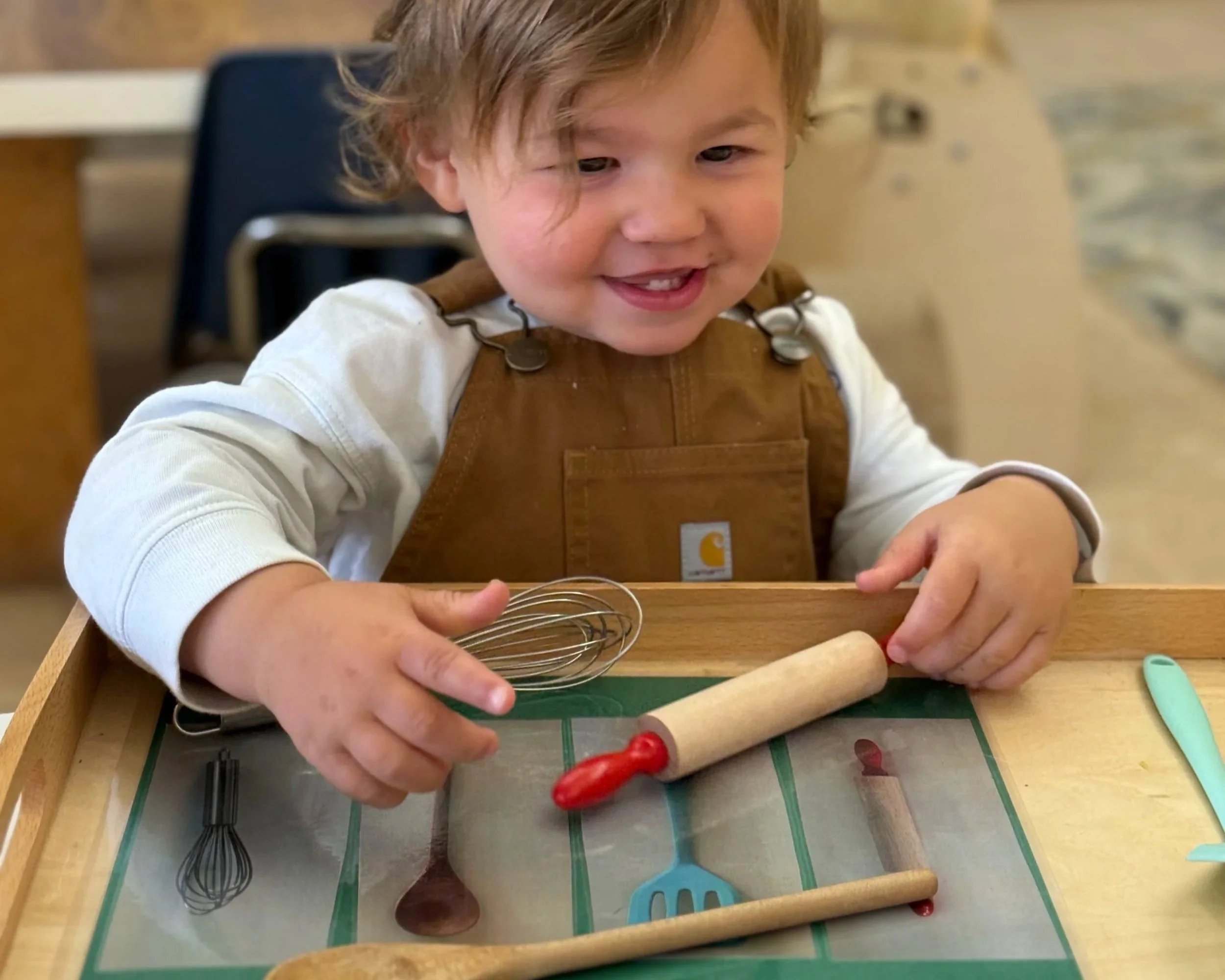
The toddler years are filled with remarkable growth, curiosity, and independence as children begin exploring the world with confidence. Our Toddler Program provides a nurturing place where children develop language, movement, and self-confidence at their own pace.


The Classroom
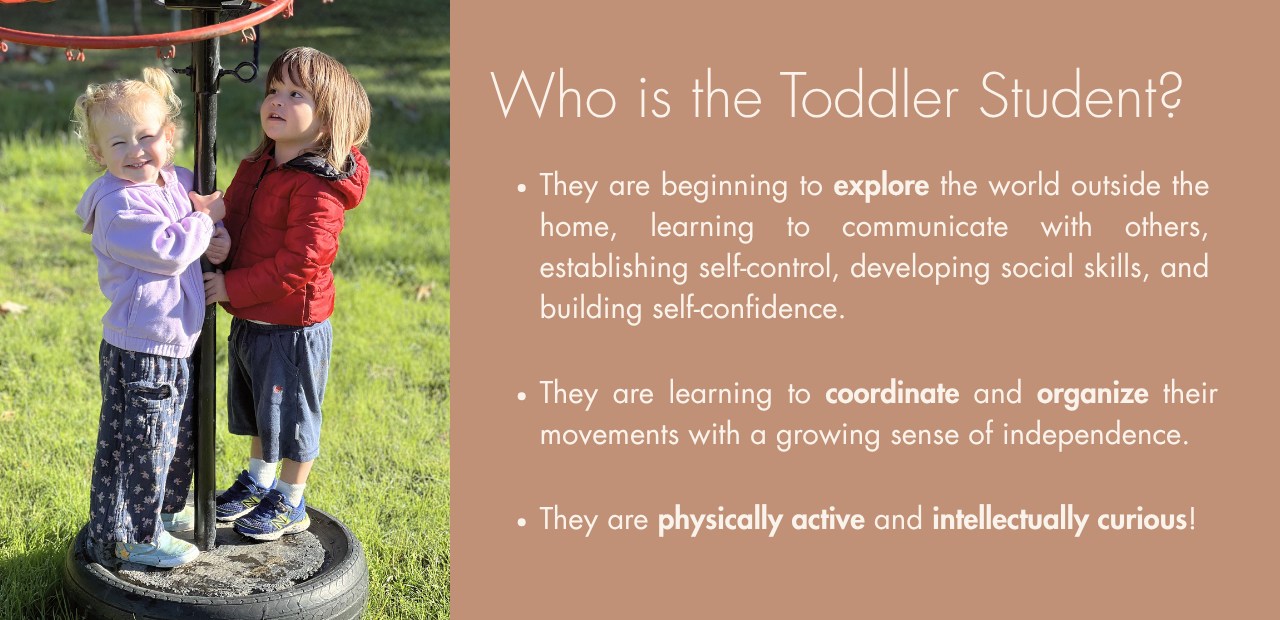
Our classroom is carefully prepared with child-sized furniture, low shelves, and inviting spaces that encourage exploration. Toddlers move freely through the space, selecting learning materials that spark curiosity and creativity. Within this supportive environment, the child will build independence, develop social skills, and begin forming friendships with their peers. The daily routines of the classroom provide the consistency that toddlers need as they learn to coordinate and organize their movements with a growing sense of independence.
The Toddler Curriculum
-
Daily living activities that help develop a sense of accomplishment and self-esteem.
The children learn how to care for their physical needs, such as dressing, undressing, using the bathroom, hand washing and table etiquette.
-
Sensorial materials encourage children to use their five senses to make sense of their world.
Foundational skills in matching, sorting and grading activities are the base of all other areas such as math, language and science.
-
Children may look at books by themselves or with friends, encouraging conversational skills.
Teachers read to individual children, as well as to the class, inviting active participation in the stories.
Children are supported in vocabulary development through the expressive use of newly acquired words.
-
Children develop mathematical thinking and reasoning through sequencing activities, and ordering activities.
Classical Montessori, as well as teacher-prepared materials, build upon the child’s understanding of quantity and number recognition.
-
Cause-and-effect activities, as well as building materials promote creativity and imagination.
Less-structured activities provide opportunities for development of language and social skills.
Outdoor play time support gross motor development.
Indoor group time helps children learn patience, self-control and improve listening skills, as well as learn to follow verbal directions.
-
Art: Children explore art through finger painting, painting with brushes, sponges, strings, and stencils. Children express themselves independently and creatively as they develop their small motor coordination.
Garden: A hands-on "Practical Life" experience where young children engage directly with nature using child-sized tools. Instead of passive instruction, toddlers build independence, fine and gross motor skills, and sensory awareness by watering plants, touching soil, and exploring garden cycles.
Music: Children are introduced to different types of music and musical instruments. Singing and movement integrate rhythm, language and physical coordination through a variety of familiar and newly introduced songs.
Physical Education: Outdoor time where children can enjoy activities designed to develop coordination, motor planning, control of movement, and cooperative play.
Spanish: With the use of natural, immersive routines rather than rote memorization, children absorb the language through conversations, songs, read-aloud stories, and hands-on practical life activities guided by our native Spanish-speaking teacher.
““Play is the work of the child.””