
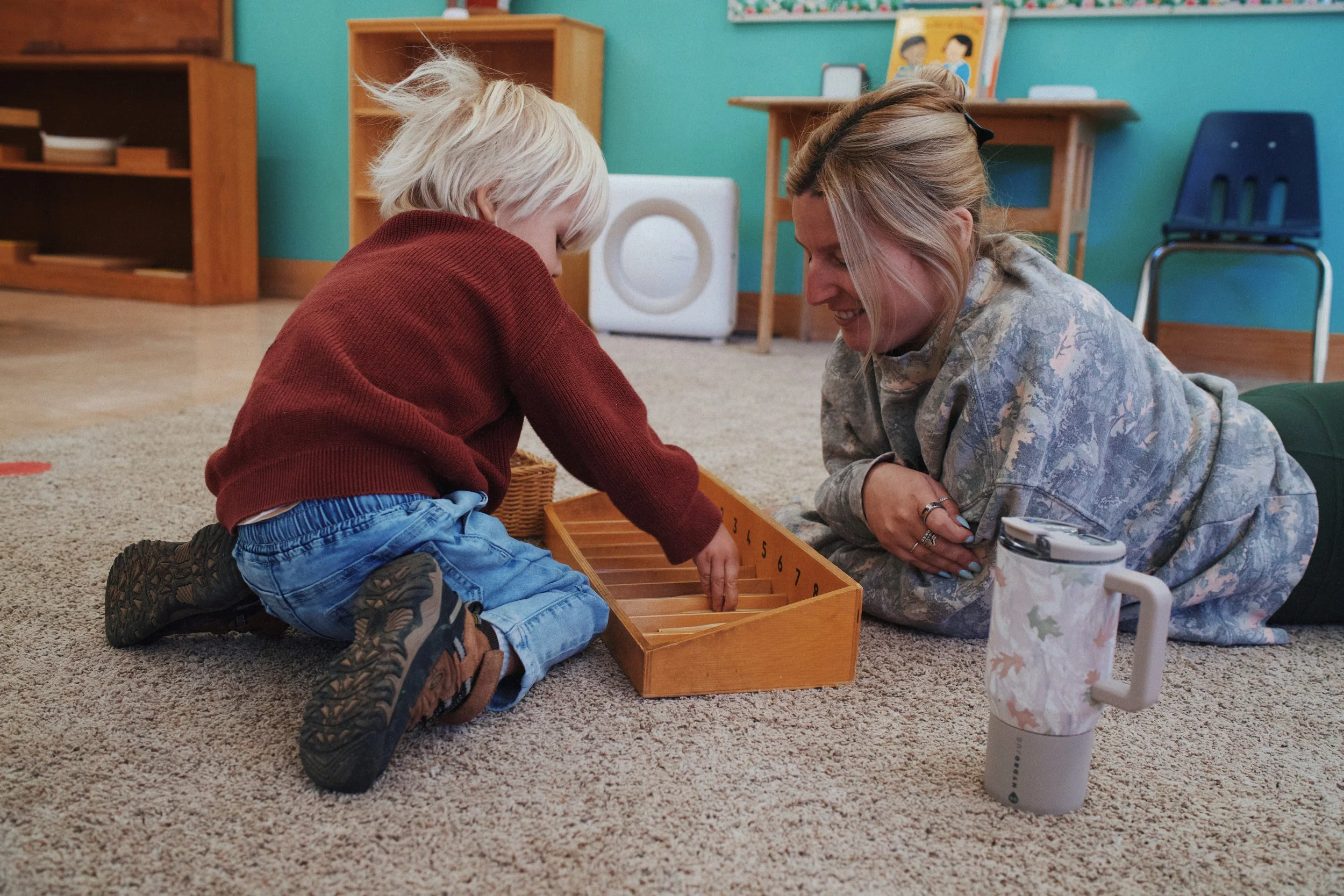
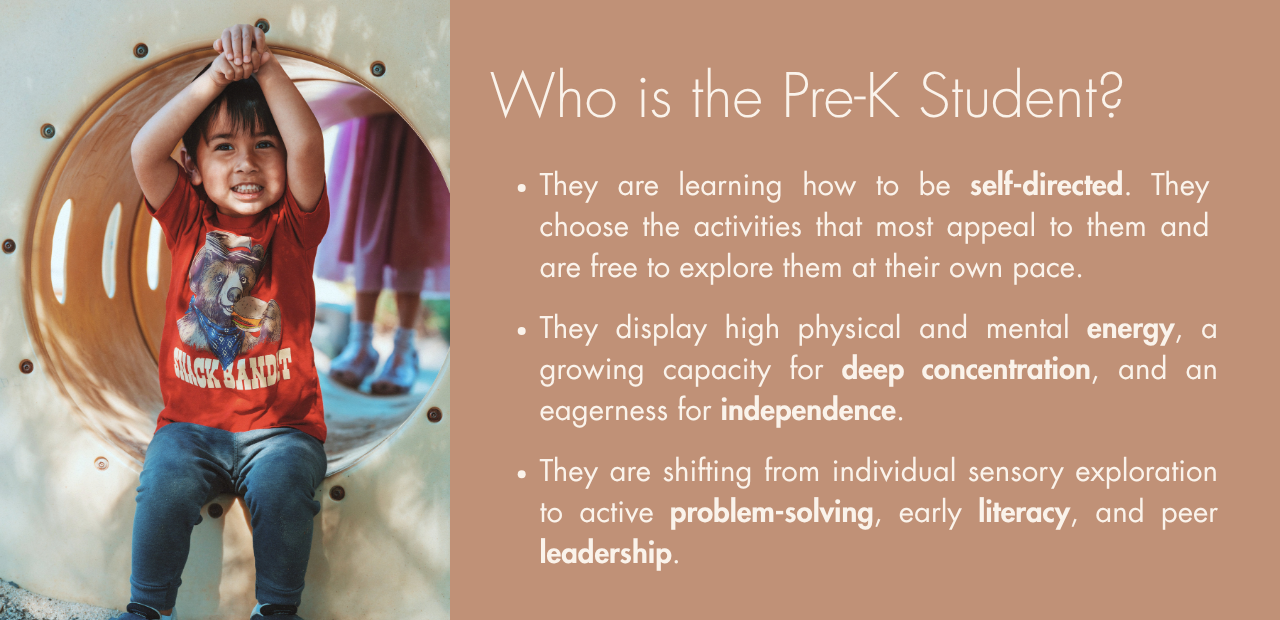
The main focus of the Pre-Kindergarten Program is to meet the developmental needs of children of this age, particularly in the areas of independence, sense of order, language expansion, refinement of movement, socialization, and toilet learning. These developmental needs are always met with the ultimate goal of helping the child become increasingly independent.


The Classroom
There are activities in the classroom that foster independence, such as choosing work, completing a sequence of tasks within the work, interacting positively with others, and completing toilet learning. There is ample opportunity for the children to move about freely, making contact with those around them and supporting their budding desire for socialization. The classroom is clean and attractive. The furniture and materials are sized to the child. The shelves are uncluttered and include safe, interesting materials to touch and manipulate.
The Curriculum
-
Children learn daily-life skills, such as how to get dressed, prepare snacks, set the table, and care for plants and animals.
Children learn social interactions, such as saying please and thank-you, being kind and helpful, listening without interrupting, and resolving conflicts peacefully.
In addition to teaching specific skills, Practical Life activities promote independence, and fine- and gross-motor coordination.
-
Children refine skills in perceiving the world through their different senses, and learn how to describe and name their experiences—for example, rough and smooth, perceived through touch.
Sensorial learning helps children classify their surroundings and create order. It lays the foundation for learning by developing the ability to classify, sort, and discriminate—skills necessary in math, geometry, and language.
-
Children given the names of everything in the classroom, taught the names of feelings, and appropriate ways to express them other than physically.
Children are encouraged to talk about everything. Besides the encouragement of conversation, language is explored through songs, rhymes, and books.
Integrates phonics, vocabulary building, and early writing naturally at each child's pace.
-
Introduces abstract numbers through concrete, physical quantities. Materials include the Number Rods, Spindle Boxes, and Golden Beads to teach counting from 1 to 10 and basic one-to-one correspondence.
-
Child-sized toilets ensure the child can sit comfortably and securely without adult assistance.
Children focus on self-care mastery, body awareness, and managing the full sequence independently.
Bodily functions are treated calmly and naturally, avoiding any shame or frustration during accidents
-
Art: Children explore art through finger painting, painting with brushes, sponges, strings, and stencils. Children express themselves independently and creatively as they develop their small motor coordination.
Garden: A hands-on "Practical Life" experience where young children engage directly with nature using child-sized tools. Instead of passive instruction, toddlers build independence, fine and gross motor skills, and sensory awareness by watering plants, touching soil, and exploring garden cycles.
Music: Children are introduced to different types of music and musical instruments. Singing and movement integrate rhythm, language and physical coordination through a variety of familiar and newly introduced songs.
Physical Education: Outdoor time where children can enjoy activities designed to develop coordination, motor planning, control of movement, and cooperative play.
Spanish: With the use of natural, immersive routines rather than rote memorization, children absorb the language through conversations, songs, read-aloud stories, and hands-on practical life activities guided by our native Spanish-speaking teacher.
““The first essential for the child’s development is concentration. The child who concentrates is immensely happy.””