
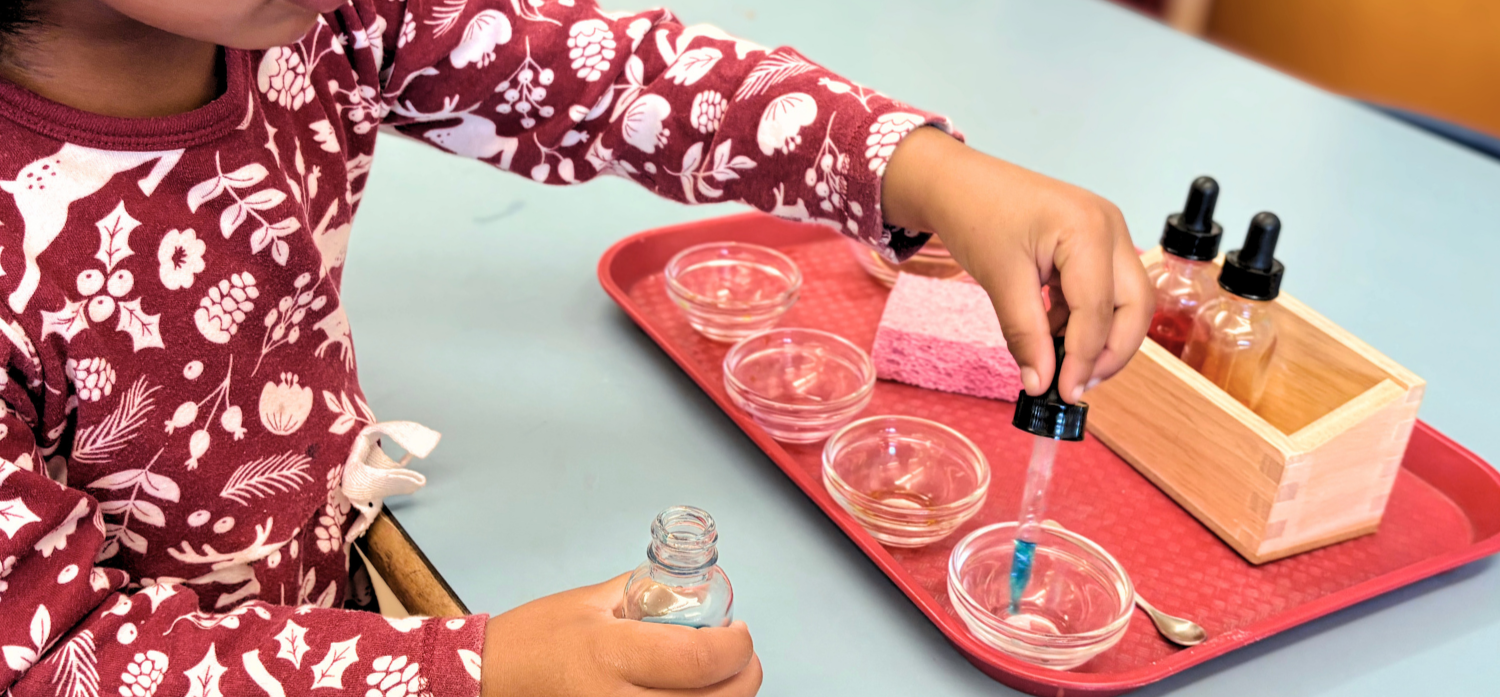
The Primary Program helps children work independently, take care of their needs, and develop a good self-image. Children have different interests at different times in their lives. Maria Montessori termed these developmental stages “sensitive periods.” Our respect for these stages and the individual variations within them gives us unique expectations for each child.


The Classroom
Within the Montessori classroom, children are free to move around the room instead of staying seated at desks. There is no limit to how long a child can work on something they have chosen. Opportunities for both individualized learning and large group experiences occur naturally in this multi-age setting. The wide variety of activities and materials nourish self-confidence, concentration, cooperation, and respect for others.
The organization of experiences and impressions is guided by a multi-sensory approach. The child discovers reading through phonics, mathematical concepts through concrete materials, and geographical relationships and scientific information through manipulating objects and real-life materials.
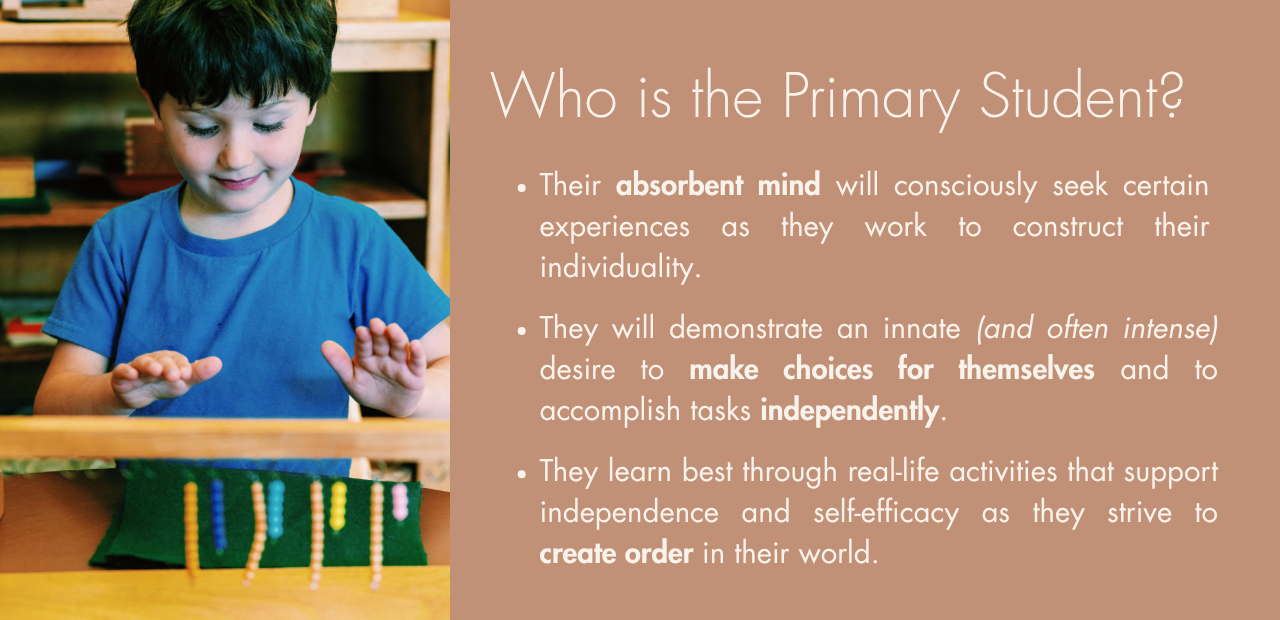
The Curriculum
-
Practical life activities include objects and materials normally encountered in everyday living experiences. These activities help students develop independence, a sense of order, the ability to focus, concentrate, build coordination, and organizational skills.
Practical Life activities:
are often the first lessons the child is invited to experience and explore
are made of beautiful and enticing materials
create the foundation for future academics
help children learn to control their movements
allow students to master the care of themselves and care for their environment
train the eye for reading and the strengthen the hand and pincer grip for writing
develop patience and understanding
Grade and Courtesy lessons:
Shaking hands, acting as hosts, using polite manners, cleaning up, serve peers first, food preparation.Examples:
Cleaning, sweeping, pouring, dressing, learning to tie, and caring for class plants and animals. -
Maria Montessori said that a primary purpose of the sensorial exercises is that “the child train himself to observe, that he be led to make comparisons between objects to form judgments, to reason and to decide; and it is in the indefinite repetition of this exercise of attention that a real development ensues.”
Sensorial activities:
enable the child to gain information through the exploration of their senses
encourage children to develop classification and discrimination skills
enhance and refine the child’s sensory awareness
develop the foundation for:
math skills
spatial relations
reading and writing
visual discrimination of length, height, width and volume
colors and shapes
Examples:
Knobless cylinders, knobbed cylinders, brown stairs, red and blue rods, color tablets, constructive triangles, binomial and trinomial cubes and of course the iconic pink tower.
-
Language is an intricate part of the classroom. Maria Montessori said, “Language is an instrument of collective thought.” It is the thing that separates us from other forms of life.
Early childhood is the sensitive period when language is formed. It is during this time that children take pleasure in listening to and then repeating the spoken language.
Language activities:
build vocabulary with big books, poetry, and daily reading aloud
create the foundation of writing and reading
introduce the sounds of the letters first
help students encode (spell) and decode (read) words by linking these sounds together
teach students to recognize letters visually before reading whole words
involve tracing letters with different textures before learn to write
challenge reading and writing abilities at the appropriate level for each child
Examples:
Sandpaper letters, moveable alphabet.
-
Maria Montessori believed that children could absorb mathematical concepts naturally. She deduced via observations that there were periods in children’s development where they absorb mathematical concepts and ideas naturally through the environment, as well as through the manipulation of concrete materials. The Practical Life, Sensorial and other areas in our Montessori classrooms help lay the foundation for math. These areas provide the children with opportunities to order, sequence, measure, and grade.
Mathematics activities:
are worked through in a sequential order
use concrete materials to help children obtain a clear vision of what they are learning
begin with teaching basics such as numeral recognition
develop concepts of addition, multiplication, subtraction and division
help to internalize the concepts of number, symbol, sequence, operations fractions, etc.
Examples:
Bead cabinet, spindle boxes, number rods, sandpaper numerals, golden bead materials, tens and teens boards, place value cards/ mats.
-
The Geography curriculum creates opportunities to explore and develop concrete foundations for understanding the world.
Geography topics include:
the seven continents (over the three-year cycle in Primary)
concrete examples of each continent’s countries, people, language, literature, dress, and wildlife
exploration and research through use of maps, puzzles, booklets, and artifacts introduce the child to the planet’s great diversity of land and people.
-
Art: Integrated with the classroom environment, Children can explore and express themselves through various art implements.
Garden: In the garden children learn about the parts of the plant, different types of seeds, basic planting and garden care.
Music: During circle time, songs, games, and different instruments are introduced. Children also learn tone and rhythm.
Physical Education: Children learn basic gross motor and manipulative skills such as running, jumping, throwing, catching, bouncing, hopping, landing and kicking. P.E. also includes key movement concepts for variety of games and activities, while allowing children to develop a positive attitude towards leading a healthy, active lifestyle.
Spanish: Lessons focus on common phrases, pronunciation learned through rhythm and songs, and vocabulary learned through senses and concrete objects.
““The goal of early childhood education should be to activate the child’s own natural desire to learn.””